A History of the Wagyu Breed
From Draft Animal to the World's Most Coveted Beef
For most of its history, the animal we now call Wagyu was never bred for the table. The word itself simply means "Japanese cattle" — wa (Japanese) and gyu (cattle) — and for centuries these beasts were valued as living machinery: hardy, patient draft animals that pulled plows through the terraced rice paddies and hauled loads across mountainous country where no other power would do. Their fine-grained, heavily marbled meat was a fortunate byproduct of a physiology built for stamina and sustained work, not a deliberate breeding goal.
Isolation did the rest. Japan's mountainous geography kept regional cattle populations separate for generations, and for a long stretch of the country's history the eating of beef was discouraged or outright banned under Buddhist influence, so the cattle were shaped almost entirely by their working role and their local environment. Distinct regional strains emerged, each with its own conformation and temperament. It was only in the 20th century — as mechanization freed the cattle from the fields and Japan opened to outside breeds — that breeders turned their full attention to carcass quality, and in doing so refined the most intensely marbled beef in the world.
The Four Strains — the DNA of Wagyu
Japanese Black Wagyu is not one uniform population but a blend of distinct strains (keito), each historically tied to a prefecture and a breeding emphasis. Understanding them is the key to understanding every modern pedigree, because breeders still blend these lines deliberately to balance marbling against growth.
- Tajima (Hyogo Prefecture) — the marbling engine. Compact, smaller-framed and slower-growing, the Tajima line produces the finest, most abundant intramuscular fat of any Wagyu strain, and it is the genetic foundation of Kobe beef. When people picture the impossible, snowflake marbling that made Wagyu famous, they are picturing Tajima. Its trade-off is size: Tajima cattle are lighter and yield less, so the line is prized for quality rather than quantity. Roughly half of the average full-blood genetics outside Japan trace to Tajima.
- Fujiyoshi (Shimane Prefecture) — the balanced line. Built largely on the legendary sire Dai 7 Itozakura, the Fujiyoshi strain offers a middle path: good marbling combined with genuine maternal ability, milk and moderate growth. It is the line breeders reach for to build productive cow herds rather than to chase a single carcass trait.
- Kedaka (Tottori Prefecture) — the growth-and-frame line. Originally bred as pack animals in the grain trade, Tottori cattle contribute size, skeletal structure, mature weight and feed efficiency while still holding respectable marbling. Kedaka blood is the classic outcross for adding frame and ribeye to marbling-heavy herds.
- Itozakura (Shimane-centered) — closely associated with the Fujiyoshi world and the second-most prominent line abroad, valued for combining growth with strong carcass performance and milk.
Those four strains all belong to one breed: the Japanese Black. But it is not the only Japanese breed to reach the West, which brings us to a point that causes more argument among breeders than almost any other.
What "Wagyu" Really Means — and Where Akaushi Fits
The word Wagyu simply means Japanese cattle — wa (Japanese) plus gyu (cattle). It is an umbrella term for the native cattle of Japan, not the name of a single breed. Japan recognizes several distinct native breeds under that umbrella, and two of them made it out before the export ban:
- The Japanese Black (Kuroge) — the intensely marbled black cattle described above, and what nearly everyone means in casual conversation when they say "Wagyu."
- The Akaushi — the reddish-gold cattle native to Kumamoto, on the island of Kyushu, where local breeders have always called them Akaushi ("red cow"). Akaushi grow larger and faster, milk well, and carry a favorable, higher-oleic fat profile and strong performance on grass — a different animal, with its own breed identity, its own herdbook, and its own breed associations.
Here is the distinction that matters, and that gets muddied constantly: Akaushi are Wagyu in the literal sense — they are Japanese cattle — but they are a separate breed from the Japanese Black, not a red color variety of it. The common marketing phrase "Red Wagyu" blurs that line and irritates a lot of serious breeders, because it implies the reds are simply the Blacks in a different coat. They are not. The accurate way to say it: there is Black Wagyu (Japanese Black), and there is Akaushi — both Japanese cattle, each its own breed. This history uses Akaushi throughout for the Kumamoto reds, and reserves the plain term "Wagyu" for the Japanese Black where common usage expects it.
1976: The First Four Bulls
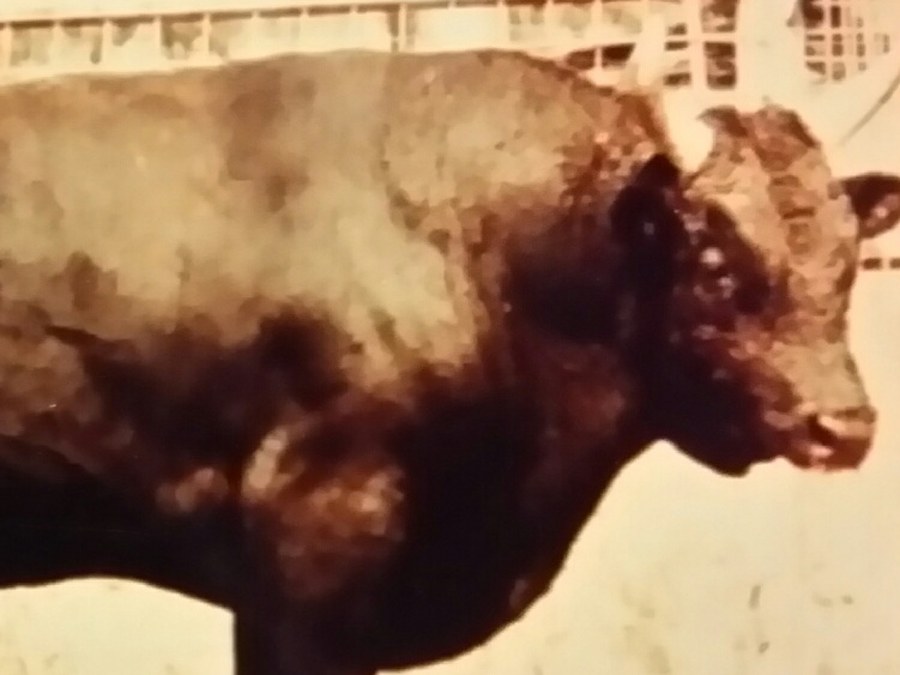
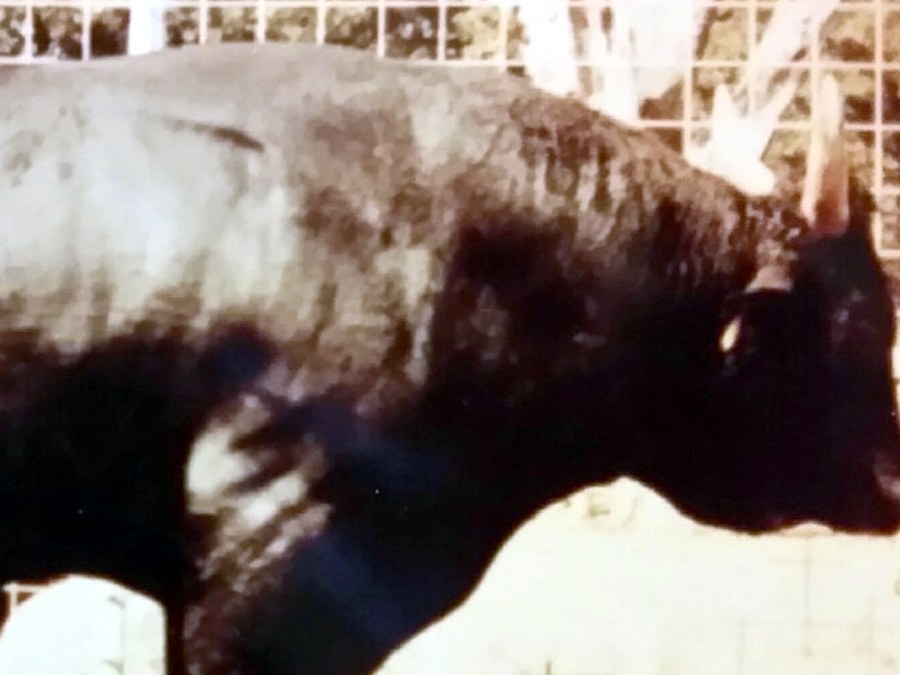
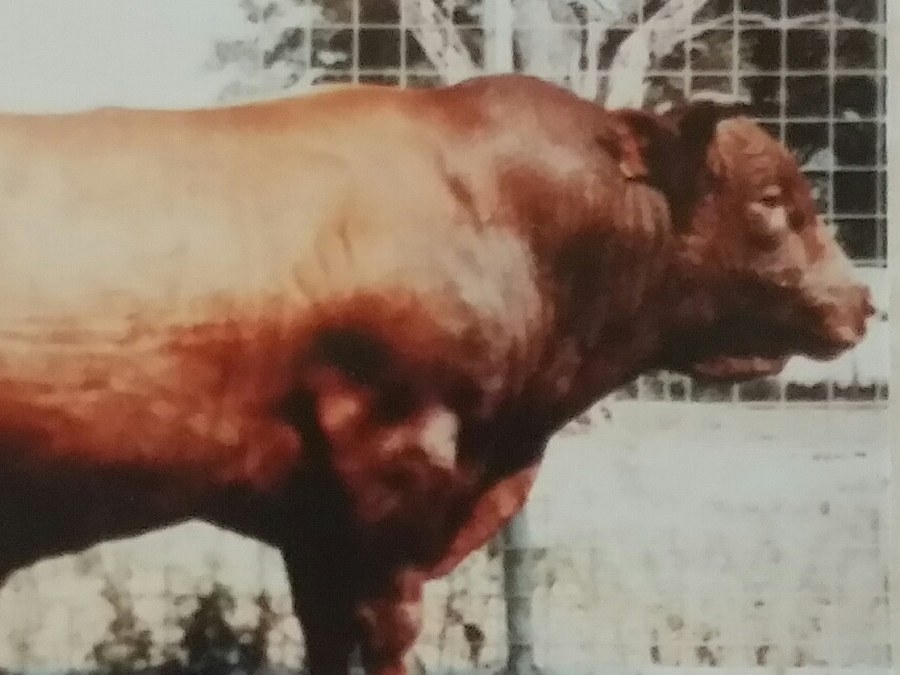
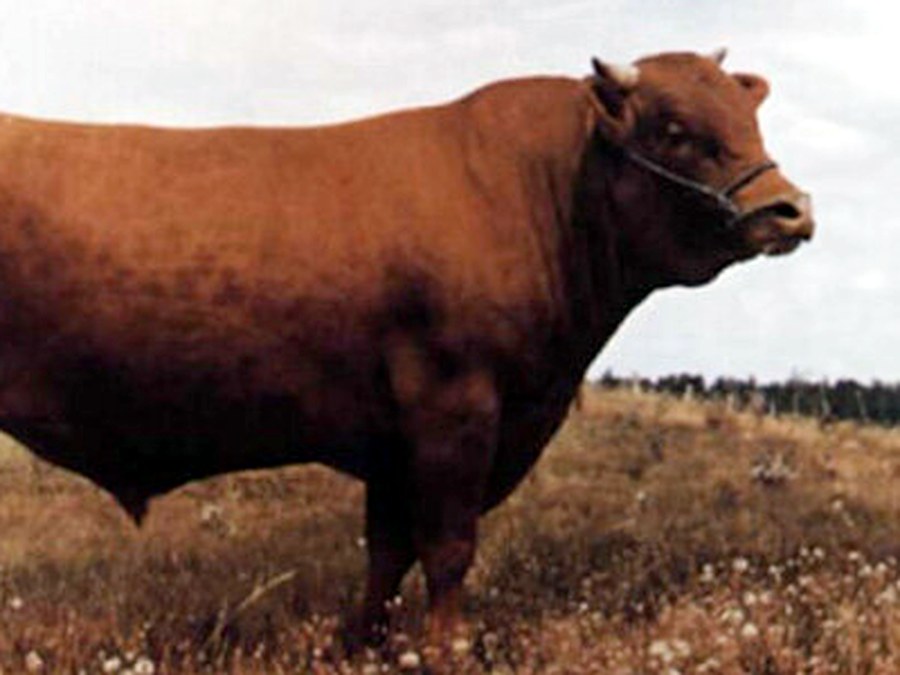
The story of Wagyu outside Japan begins not with a shipment of thousands but with a handful of bulls. According to a 1992 newspaper account — the earliest primary source — the first four Wagyu arrived in the United States on March 31, 1976, bought by the Texas cattleman Morris Whitney together with a Japanese partner. It was the first Wagyu ever exported from Japan.
Hear it from the man who owned all four bulls
Decades later, at a Wagyu auction in April 2017, we recorded Fred Hildebrandt — the Texas rancher who came to own all four of the 1976 foundation bulls — telling the story in his own words. As far as we know, it is the only firsthand account of the 1976 import preserved on tape. Listen:
In Hildebrandt's telling: Morris Whitney, a real-estate man, went to Japan and was able to buy the bulls — Wagyu being a recognized national treasure — with the purchase bank-financed. He is emphatic on a detail the popular story gets wrong: the bulls did not come through Mexico. Blocked from direct U.S. import by USDA restrictions, they were held in island quarantine, then admitted into Canada (accepted for roughly five or six months), brought into Montana, and eventually down to Texas. And their true nature was settled at a blood-typing lab in College Station, where the chromosomes showed these cattle to be neither Bos taurus nor Bos indicus, but a genetic breed all their own — Wagyu.
Two were Japanese Black: Mazda, a Tottori (Kedaka) bull whose descendants would later top modern marbling tests despite the growth reputation of his line, and Mt. Fuji, a Tajima bull from Hyogo prized for calving ease and maternal traits. Two were Akaushi: Rueshaw and Judo, both from Kumamoto. (The fourth bull is Judo — never "Mikimoto," a name that appears in no authentic record.) Rueshaw was no ordinary animal: the 1975 Japanese Red National Champion and, by repute, the only national champion ever permitted to leave Japan; he became the very first Wagyu registered with the American Wagyu Association, and a line-bred descendant would sell, decades later, for a Wagyu world-record half-million dollars.
A note on the folklore: several breeders tell the 1976 story differently — that the four bulls were a gift from the Emperor of Japan to the Governor of Hawaii as a post-war goodwill gesture. It is a wonderful story, and it circulates widely, but the documented record does not support the imperial-gift version: the primary sources — and Hildebrandt's own account above — describe a straightforward commercial purchase by Whitney, bank-financed, not a gift. The Canada detail, by contrast, is not folklore at all: Hildebrandt, who owned the bulls, states firsthand that USDA rules blocked direct import, so the animals were quarantined and admitted through Canada before crossing into Montana and on to Texas — while insisting, just as firmly, that they never passed through Mexico. Where a myth (the imperial gift) and a firsthand account (the Canada route) diverge, we follow the man who was there.
Because there were no full-blood Wagyu females in America, these bulls could only be crossed onto Angus, Hereford, Holstein and Brangus cows while Colorado State University collected and studied their semen. Whitney formed a venture called Kobe Beef Producers Inc., and around 1979 the bulls passed to a Georgetown, Texas veterinarian, Dennis Wendt, who bred and marketed the first American "Kobe beef." When that venture faltered, the bulls became the object of a legal fight. By Fred Hildebrandt's firsthand account, the managing vet had run up ruinous bills and, when the financiers walked away, taken the bulls himself; Hildebrandt sued, the vet filed bankruptcy, and when the court moved to hand the "worthless" bulls back, Hildebrandt tendered a certified check the court accepted — and was awarded the four bulls and the corporations, owning them until they died. A Rosebud, Texas rancher (alongside a retired stone carver, Don Lively), he discovered that the real value lay in the bulls' semen, and in the fall of 1993 held a complete dispersal sale of some 13,000–14,000 straws, advertised nationally, with buyers coming from as far as Australia. For fifteen years these four bulls were the only Wagyu genetics in the country, and their blood endured — Rueshaw's and Judo's through the American Akaushi, Mazda's and Mt. Fuji's through the black herds. As for Mazda himself, the story goes that he died at seventeen, chasing after a cow.
The Percentage Era
For nearly two decades after 1976, one fact governed everything: there were no full-blood Wagyu females outside Japan. Every Wagyu animal bred in America or Australia before 1993 was therefore a percentage animal — a crossbred carrying some fraction of Wagyu blood, graded up generation by generation, but never a purebred. The genetics existed abroad, but the closed herd of true full-bloods remained locked inside Japan. Everything changed in a single narrow window in the mid-1990s.
1993–1997: The Wave That Seeded the World
Between 1993 and 1997, a series of carefully organized exports finally brought live full-blood cattle — bulls and females — out of Japan. This short window created the entire global full-blood Wagyu industry, and nearly every elite pedigree in the world today traces back to a handful of animals that moved in these few years.
Why the door opened at all is a story told firsthand by Bruce Hemingson, one of the Americans who selected the foundation cattle in Japan and helped set up the quarantine there. By his account, the opening was rooted in reciprocity: Hemingson had earlier helped Japan acquire American Holstein cows to build up its dairy industry, and in return Japan was willing to let America take some cattle home — temporarily easing the tight controls on live export. Working on the ground, Hemingson helped hand-pick foundation animals, walking Japanese herds to choose the bulls and cows that would carry the breed abroad. It was painstaking, once-in-history work: the animals chosen in those few trips became, quite literally, the genetic foundation of Wagyu everywhere outside Japan.
The Mannett Group (later World K's / Westholme) led the way. In July 1993 the first shipment carried the bulls Michifuku and Haruki 2 together with a small group of Tajima-influenced heifers — among them Suzutani, Rikitani and Okutani — initially through the Wagyu Sekai program in Canada. The first full-bloods ever born outside Japan came from this group; Okutani produced Fujiko, the first U.S.-born full-blood, in 1994. Michifuku would become perhaps the most influential marbling sire in Western history, and a second Mannett shipment in 1994 added the rare Kenhanafuji — the "International Bull of Mystery," a Fujiyoshi bull carrying no Tajima blood at all — along with Takazakura and more foundation females.
Japanese Venture Partners (JVP) imported another pillar group in 1994, headed by Fukutsuru 068, a pure-Tajima bull who would rank #1 for marbling in the U.S. sire summaries for fifteen straight years, alongside the massive Kikuyasu-400 and Yasutanisakura.
Takeda Farm, the program of Japan's exacting breeder Shogo Takeda, exported its "TF" series of black bulls beginning in 1994 — including Itomichi 1/2, Kikuhana, Itohana 2, Kinto and Terutani (TF40) — together with roughly thirty-five black females, and later the marbling titans Itoshigenami (TF148) and Itoshigefuji (TF147). Itoshigenami would go on to sire more registered progeny than any other foundation bull in Australia.
The Akaushi line came entirely separately — and it has the best story of all. While Bruce Hemingson was in Japan selecting the black foundation cattle, a Texas heart surgeon named Dr. Al Wood and his wife Marie asked him to do the same for the reds. So Hemingson also hand-picked the foundation Akaushi: the bulls Shigemaru, Tamamaru and Hikari — following Judo and Rueshaw, the two Kumamoto reds from the 1976 import — along with a band of elite red females, the genetics that became HeartBrand and the source of essentially all American Akaushi. This was the Woods and Hemingson, not Takeda — the single most-corrected attribution in Wagyu history.
Every one of these animals first had to survive quarantine — and not the way the popular story tells it. Before any Wagyu could board a plane, it spent roughly six months in quarantine in Japan, tested before and after, at a facility Shogo Takeda had built and gotten approved by American inspectors for exactly this purpose. Takeda and Hemingson worked the logistics out between them. It is here, in that Japanese quarantine, that the breed's best story unfolds.
One of the finest Akaushi females, Akiko, came up open — not pregnant — during quarantine. In a founding group of only a handful of cows, wasting a season from one of the best was unthinkable. But breeding her was nearly impossible: the elite Akaushi sire lines were in Kumamoto, on the island of Kyushu, and cattle and semen could not simply be moved across Japan's prefecture lines. By Hemingson's firsthand account, they arranged to meet a man in a grocery-store parking lot and paid $5,000 cash for a single straw of the elite sire Dai 10 Mitsumaru. Then they slipped into the quarantine facility after dark; with no chute available, they caught Akiko and pinned her against the wall while a vet inseminated her. It took. Akiko arrived in America already carrying the calf and gave birth here to Big Al — the first full-blood Akaushi born on American soil and a cornerstone sire of the HeartBrand program. It is the kind of history no pedigree page can capture: the American Akaushi breed traces, in part, to a clandestine midnight breeding and a straw of semen bought in a parking lot.
Finally, in 1997–98, Chris Walker's Westholme program, sourcing through the ET Japan Company in Hokkaido, imported the three "patriarch" bulls known by their tags — Hirashigetayasu (001), Itomoritaka (002) and Kitateruyasudoi (003) — and routed the bulk of a large group of females onward to Australia, seeding that country's now world-leading herd.
The Door Closes: The Export Ban
The window did not stay open long. Around 1997, Japan formally recognized Wagyu as a national treasure and effectively banned the further live export of the cattle and their genetics. What had trickled out in the preceding few years became — permanently — the entire foundation gene pool for the rest of the world. No significant legal export of live Japanese Wagyu or its germplasm has occurred since.
This is why the founder numbers matter so much. Careful reconstruction of the export records puts the total at 221 animals forming the genetic basis of all full-blood Wagyu outside Japan — 188 Japanese Black and 22 Red (Akaushi) — of which roughly 183 were shipped live, leaving an effective breeding base of somewhere around 150 to 170 foundation females. Every full-blood Wagyu raised in the West today descends from this remarkably small pool. That scarcity is the source of both the breed's prestige and its most serious long-term challenge: the near-universal presence of a few key ancestors — the great sire Yasumi Doi J10328 appears again and again across the top pedigrees — means the global herd carries a real genetic bottleneck that breeders actively manage through careful outcrossing.
The Legend of Kenhanafuji
No founder-era account is complete without Kenhanafuji, the rarest of the imported bulls and, by reputation, the highest-selling Wagyu bull of all time — the "International Bull of Mystery." Genetically he stood apart from the celebrated Tajima marbling sires, carrying roughly three-quarters Fujiyoshi and one-quarter Kedaka blood and no Tajima at all, which made him a prized maternal sire producing large-framed, productive, feed-efficient daughters. Only a handful of North American ranches ever held semen on him, keeping straw prices extraordinarily high. The colorful tale that he was purchased specifically to control his genetics and keep them from a rival is the kind of story the Wagyu world loves — best enjoyed as legend rather than documented fact.
Quarantine, LaGuardia, and the Record
A persistent story holds that the founder cattle spent six months quarantined on an island near LaGuardia. The reality is more interesting, and it comes in two registers — the documented record and the firsthand memory of the men who were there.
What the record documents: the first 1990s shipment, in July 1993, flew on a livestock-equipped Northwest Airlines Boeing 747 from Tokyo (Narita) to New York, brokered by J.W. "Buck" Wright of Idaho, carrying the three foundation cows and the bulls Michifuku and Haruki 2. The animals passed 60 days of quarantine in Japan and 30 days in New York, then moved to Iowa — the cows to a genetics facility in Sioux Center and the bulls to Hawkeye Breeders in Adel. A separate 180-day quarantine attaches to the Akaushi routed onward to Canada. There was no six-month island quarantine at LaGuardia; the long quarantines were in Japan and Canada, and New York was an arrival point.
What Bruce Hemingson remembers — and he rode across the Pacific on the plane with the cattle — fills in the human texture the record leaves out. By his account the charter was a staggering expense, on the order of $250,000; the aircraft refueled in Anchorage, Alaska on the long haul before continuing to New York; and once on the ground the animals were dispersed for collection, the Akaushi genetics ultimately gathered up by the outfit that became HeartBrand. Some of these specifics — the exact cost, the Anchorage stop, the New York airport — are his firsthand recollection rather than documented fact, and different shipments moved on different aircraft; we relay them as the memory of a man who was on board.
And the New York arrival itself, by Hemingson's telling, nearly ended in disaster. The aircraft touched down into brutal heat during a major airport labor strike, and there was no one to unload the animals. In an un-ventilated cargo hold in that heat, the cattle began panting and showing heat-stroke symptoms; Hemingson was certain they would die in the plane. He ran the length of the airport searching for anyone who could operate a forklift, and when he finally found one, he began peeling off $100 bills and piling them on until — several hundred, perhaps a thousand dollars later — the operator drove out and got the cattle off the plane in time. The entire foundation of a breed, by this account, came within an overheating hour of being lost on a tarmac in New York. Hemingson, a friend of Takeda's and one of the quiet godfathers of Western Wagyu, saved it with a fistful of cash and a dead run across a terminal.
A Small Beginning, a Global Legacy
The global Wagyu industry — worth billions and spanning the United States, Australia, Europe, South America and beyond — rests on a founder population that could have fit in a few pastures. From four bulls in 1976, through a tightly audited handful of animals in the 1990s, to a door that closed and never reopened, the breed's spread is a story of scarcity, foresight and careful stewardship. Every full-blood raised outside Japan today is a living link back to those few founders — the marbling of Michifuku and Itoshigenami, the maternal strength of Kenhanafuji and Itomoritaka, the championship blood of Rueshaw — carried forward in every straw, every embryo, and every calf.
Explore the founders individually — their bloodlines, histories and photographs — in the foundation animals gallery.
Primary source: Wagyu International (wagyuinternational.co), whose detailed reconstruction of export records and bloodline histories underpins the founder numbers and import accounts summarized here, corroborated by breeder histories including Prime Valley Farms, Akaushi Genetics, HeartBrand, Rocking 711 and Reserve Cattle Co.
Browse every foundation bull and cow — full histories, bloodlines, and photos.
View the foundation animals →